How do you maintain a timber deck?
Murat Şen · Published: · Updated:
Timber deck maintenance has three basic steps: wash the surface with a brush and water, let it dry completely, and apply a suitable wood oil. The interval depends on the product used and how much sun the surface gets; most manufacturers recommend one or two coats a year on surfaces in full sun. It is time when the colour has faded or water soaks in instead of beading on the surface. A deck's life depends on its substructure as much as its boards, so maintenance also means checking the joists and screws.
In this guide · 6 sections
When does a deck need maintenance?
The surface tells you more than the calendar. It is time for maintenance when you see any of these:
- Water no longer beads on the surface but soaks straight in.
- The colour has clearly faded or is turning grey.
- Moss, dark patches or a slippery film have formed.
- Fine cracks or raised fibres appear at the board ends.
Decks in full sun and rain show these signs sooner. A deck in shade or under cover needs maintenance less often.
How do you maintain a deck, step by step?
- Clear: move pots and furniture off the deck. Sweep leaves and soil out of the gaps between boards; the gaps are there to let water drain.
- Wash: wash with plenty of water and a stiff brush, along the length of the boards. For moss or dark patches use a cleaner made for timber. Keep a pressure washer well away from the surface; it can raise the grain.
- Dry: oil goes on dry wood only, so let the deck dry completely after washing. Don't do it when rain is forecast.
- Light sanding: if fibres have lifted or the surface is rough, sand lightly and remove the dust.
- Oil: apply the wood oil with a brush or pad in thin coats, along the boards. Pay extra attention to board ends, where most water gets in. Wipe off any oil that hasn't soaked in.
- Check: tighten loose screws and note any boards that rock or sag.
Which oil or paint should you use?
Decks are usually finished with penetrating oils. Oil does not form a film on the surface, so it does not blister or flake as it wears, and the next coat goes straight on top.
Option | Look | Upkeep |
|---|---|---|
Clear wood oil | Natural colour of the wood | Renewed often, easy to apply |
Tinted wood oil | Adds tone, grain stays visible | Slightly longer between coats |
Opaque paint | Hides the wood colour | Worn areas can blister; old coats are sanded before recoating |
Film-forming finishes such as varnish are generally not recommended on surfaces you walk on: they scratch and the worn paths show. Iroko and teak decks are usually oiled, not painted.
Can a grey deck get its colour back?
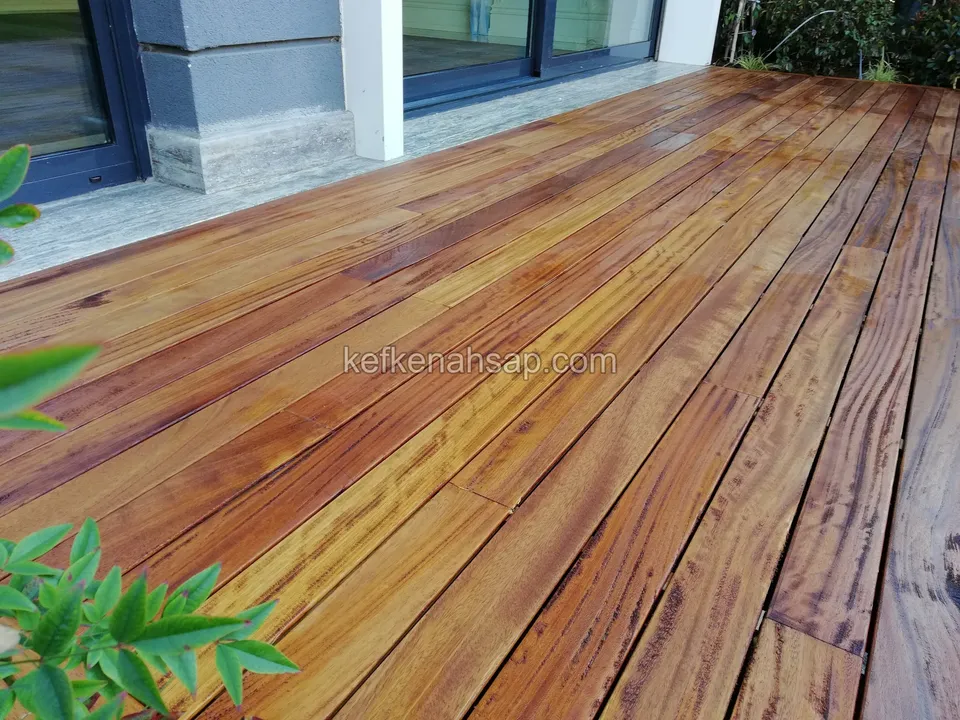
Usually, yes. Greying stays on the surface. Once the surface is cleaned and sanded, the wood underneath shows and oiling brings the colour back. On most pressure-treated pine, the greenish tint from treatment fades over time; oil can add colour back to the wood.
Which mistakes shorten a deck's life?
- Blocked gaps: soil and leaves between boards hold water and rot the board edges.
- Water trapped underneath: if the space below the deck is not ventilated, the joists stay damp. The substructure, more than the boards, decides how long a deck lasts.
- Oiling wet wood: the oil cannot soak in and leaves a sticky film.
- Pressure washing up close: it raises the grain and roughens the surface.
- Pots straight on the boards: water collects under the pot and leaves a mark. Stand pots on feet or a grille.
When does a board need replacing?
Replace boards that go soft and give when you press a screwdriver into them, that crack deeply, or that flex underfoot. Deck boards are fixed with screws or hidden clips; we use both, depending on the job. Either way, bad boards can be taken out and replaced one by one; there is no need to lift the whole deck. If the problem shows on many boards at once, the substructure, meaning the joists and supports, needs checking too.
We maintain and repair decks we built and decks laid by others. See our decking and flooring page or send us a message.
Frequently asked questions
- How often should a deck be oiled?
- It depends on the product and how much sun the deck gets; most manufacturers recommend one or two coats a year in full sun. It is time when water soaks in or the colour fades.
- Can a deck be pressure washed?
- Not up close or at high pressure; it raises the grain. A stiff brush and plenty of water are safer.
- Should a deck be painted or oiled?
- Oil is usually preferred. It forms no film, so it does not blister and the next coat goes straight on.
- Does one rotten board mean lifting the whole deck?
- No. Boards are fixed with screws or clips, so a bad board can be replaced on its own.
- Do you maintain decks built by other companies?
- Yes. We also maintain and repair decks laid by other companies.